
Early Spring Sun Exposure: How It Really Works (And Why Your PNW Garden Timing Depends on It)
It looks like spring is here. The daffodils are blooming, the cherries are putting on a show, and that first warm afternoon has you standing in the yard thinking it's time to plant. But that warmth is deceiving you. The air might feel like 60 degrees, but your garden is telling a completely different story.
Early Spring Sun Exposure Isn't What You Think
At our latitude in the Pacific Northwest (around 47°N for Seattle, 45°N for Portland), the sun's position changes dramatically between March and June. In mid-March, the sun peaks at roughly 38 degrees above the horizon at solar noon. By late June, it climbs to about 65 degrees. That 27-degree difference changes everything about what your garden beds actually receive.
A lower sun means longer shadows. Your house, your fence, your neighbor's trees, all of those cast shadows that stretch two to three times further in March than they will in summer. A bed that gets eight hours of direct sun in July might only see three or four hours right now, and the light hitting it is less intense because it's arriving at a steeper angle through more atmosphere.

We're also working with less daylight. March gives us roughly 12 hours from sunrise to sunset. By the summer solstice, we're up near 16 hours. That's four extra hours of photosynthesis your plants aren't getting yet. And then there's the PNW wildcard: cloud cover. Even on what feels like a bright March day, a lot of that light is diffused through clouds, scattered and weaker than the direct sun your warm-season crops need.

Soil Temperature Is the Number That Matters
Here's what most people get wrong. They check the weather forecast, see 58°F, and think that's what their garden is working with. It's not. Your soil is running 10 to 15 degrees cooler than the air temperature in early spring, and soil temperature is what controls germination and root growth. A $5 soil thermometer pushed four inches into the bed at 8 a.m. (before the sun warms things up) gives you the real number. In March, most PNW beds sit between 42 and 50 degrees at root depth.
What to Plant Now vs. What to Wait On
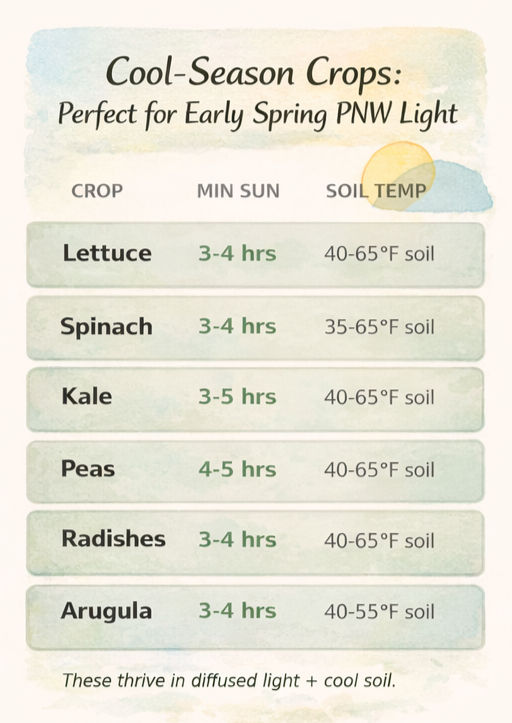
Cool-season crops are built for this. Lettuce, spinach, kale, peas, radishes, and arugula all germinate in soil as cool as 40°F and grow well with just three to five hours of direct light. They actually prefer the cooler temperatures and bolt (go to seed) when it gets too hot. Early spring in the PNW is exactly what these plants want.
Tomatoes, peppers, squash, cucumbers, beans, and corn are a different story. These need soil temperatures consistently above 60°F, eight or more hours of strong direct sun, and warm nights. Putting them out in March is basically setting money on fire. They'll sit there, stressed and stunted, until conditions catch up in late May or June.

Use Your Microclimates
Every yard has warm spots and cool spots, and knowing which is which is how you get ahead. Your south-facing bed against the house wall absorbs and reflects heat, making it your warmest, earliest-to-plant zone. An east-facing bed gets gentle morning light, perfect for leafy greens that scorch in hot afternoon sun. The north side of your house? That's your shade garden. Ideal for spinach and kale, even into summer when other spots get too hot.
Pay attention to fences, tree canopy (especially deciduous trees that haven't leafed out yet but will shade everything by May), and hard surfaces like concrete or stone that hold and radiate heat.

Map It Once, Use It All Season
Here's the single most useful thing you can do to understand your early spring sun exposure: pick a clear day and check your beds every two hours from 8 a.m. to 6 p.m. Write down which spots get direct light and which sit in shadow. Do it once in March and once in June. You'll have a sun map that takes the guesswork out of every planting decision.
This is exactly what I help my Executive Kitchen Garden clients figure out. Designing a garden that works with your actual light patterns, your actual soil conditions, your actual space, not some generic planting calendar that doesn't know your yard.
Not sure how this applies to your garden? Let's talk about it. Book a Kitchen Garden Consultation Session and we'll look at your space together.
Grow With Me & Get Monthly Garden Tips:
March bookings are open for both the Executive Blueprint and one-on-one consultation sessions.
→ The Blueprint is the full design phase - soil assessment, crop selection, succession plan, and layout - everything covered in this post, done for your specific space. Book here.
→ Consultation sessions are a good fit if you want to work through one piece of it yourself with guidance. Either way, the spring planting window sets the deadline, and spots fill before it arrives. Book here.

Comments